Olin Dunmore
- Ship
- Mast of Crows Able Seaman
- Position
- Able Seaman
- Faction
- Hookyard
- Territory
- Bone Reef Station
Backstory
OLIN DUNMORE: A CHRONICLE OF THE STRIKER
The Wapping Years, 1688–1707
Olin Dunmore’s earliest memory was not a sight but a sound — water dripping somewhere inside the walls of his mother’s lodging house in Wapping, a steady tick that measured out his childhood in single drops.
The building itself was a narrow
The building itself was a narrow brick thing, three stories and damp, let to sailors and bargemen by the week.
His father Thomas was a ropemaker whose hands had been permanently shaped by the work, fingers braided and stiff, the skin perpetually raw where hemp had worn it away. The man smelled of tar and the alkali water used to soak the fibers, a scent that clung to his clothes and eventually to the house itself.
Thomas drank. This was not remarkable — half the men in the ropewalks drank — but he did it with a particular dedication.
By the time Olin was eleven
By the time Olin was eleven, in 1699, Thomas’s debt to the gin-shops and small creditors had accumulated to the point where the Fleet Prison became inevitable. He walked in one morning in spring and did not come home.
Three years later, a man came to the lodging house to tell Olin’s mother that Thomas had died in the cell block. The man had shared quarters with him and remembered the name. Olin’s mother Mary wept for two hours in the kitchen.
Then she let his room to a Portuguese rigger who paid double the going rate, and the house absorbed one more person into its constant rotation.
Mary Dunmore kept the place running
Mary Dunmore kept the place running through will and gin. By evening, she would be warming a glass by the hearth, and it would be gone before her son came in from the docks.
She died in 1705, when Olin was seventeen — influenza, the neighbor called it, though Olin understood it as a quieter kind of surrender, the way a rope gives way when the strain exceeds the fiber. He was not there when it happened.
He was working a cargo of pitch and timber, learning the precise angle at which a splice will hold and the moment at which it fails.
For two years after her death
For two years after her death, he kept the lodging house open alone.
The work was simple and depressing — renting out his mother’s bed as soon as the sheets could be turned, sleeping himself in the cellar where the dripping sound continued, unchanged and unchanging, a rhythm that had marked every significant moment of his life.
He learned to move through that dark without stumbling, the way a sailor learns to move through a tilting deck. His hands began to resemble his father’s — scarred, rope-burned, marked by the work in ways that would never heal completely.
The Press, 1707
The Press, 1707
In the spring of 1707, when Olin was nineteen, the Navy came to the docks.
The War of Spanish Succession had consumed men like nothing else, and the recruiting officers moved through the ropewalks and timber yards with cudgels and an appetite. They came at dawn, roping wrists and hauling bodies toward the boats.
The quota was everything. Olin saw
The quota was everything. Olin saw them coming and did not run — he did not yet understand that running was possible.
The lieutenant’s name was Graves. He was a thin-faced man with teeth like a rat’s and the particular cruelty of a small authority given sudden power. He seized Olin by the collar in front of six witnesses, his free hand already reaching for the rope that would bind him.
What happened next took three seconds.
Olin’s scarred arm — the rope-strong
Olin’s scarred arm — the rope-strong arm, the one that had learned where knots slip and where they hold — moved with the economy of a man who had spent his entire adolescence learning the geometry of failure.
There was an adze leaning against the timber stack behind him. It had not arrived there by accident. Nothing in his life had ever been by accident.
The blow was vertical and economical.
It drove down through the angle
It drove down through the angle of Graves’s skull in a way that did not require strength so much as understanding — the same understanding that kept a splice from failing, that told you when a rope had been weakened and was about to snap.
The lieutenant fell as though his strings had been cut. The other pressmen hesitated. In that hesitation, Olin moved toward the water.
He stowed aboard a merchant vessel bound for Jamaica1, riding in the hold among cargo and rats, existing in the dark between the deck beams for weeks. He drank bilgewater. He ate hardtack that had been hardtack through multiple voyages.
He listened to the wood work
He listened to the wood work and creak, to the groaning conversations of the ship around him, and he waited to see if anything would kill him.
Nothing did.
The Caribbean Emergence, 1707–1725
Port Royal received him without questions
Port Royal2 received him without questions. The heat was a physical weight, the kind of thing that changed how a man moved and thought.
A man with strong hands and no history could find work in a dozen places — the sugar fields, the timber lots, or, if he was careful enough to avoid the authorities, on a vessel that asked no one where they came from or what they had done.
He worked merchant runs first — the coastwise traffic that kept the islands fed, the sloops and schooners that moved sugar and molasses northward, rum and salt pork southward. The work was steady, the pay was thin, and the captains asked nothing.
He learned the Caribbean in the
He learned the Caribbean in the way a man learns a language by hearing it spoken by people who assume he understands — through immersion, through error, through the gradual recognition of patterns that had always been there.
Somewhere in that decade, the shape of his life changed. The word pirate began to mean something different in Port Royal, a word that shifted from outlaw to employment to identity.
He gravitated toward ships that asked less about cargo manifests and more about a man’s ability to handle himself in a boarding action. He gravitated toward captains who divided the take by shares rather than wages, who ran the deck by something closer to consent than hierarchy.
By 1725, Olin Dunmore was a
By 1725, Olin Dunmore was a striker aboard the Mast of Crows3 — the man who threw the heavy implements, the grapnels and hooks that caught rigging and flesh alike. His forearms had thickened beyond anything his father’s had achieved.
His face had been further marked by a phosphorus fire years ago, the lashes burned away, the lids perpetually stung-looking. His beard was black and knotted with tobacco and the salt spray of eighteen years at sea.
He was not handsome. He had stopped expecting anyone to say so. Children stopped crying when he entered a room only because they had run out of breath.
He was dangerous — not the
He was dangerous — not the dangerous of a duelist with a code or a soldier with a flag, but the older, simpler dangerous of a man who had been hungry and cold and who had learned that the simplest solution to a problem was the one most likely to work.
His eyes tracked movement the way a hunting bird tracks prey. He was never more than a step away from the nearest weapon, and he knew exactly where it was.
The arrangement suited him. He did not expect it to end well, and that, too, suited him perfectly.
Appearance
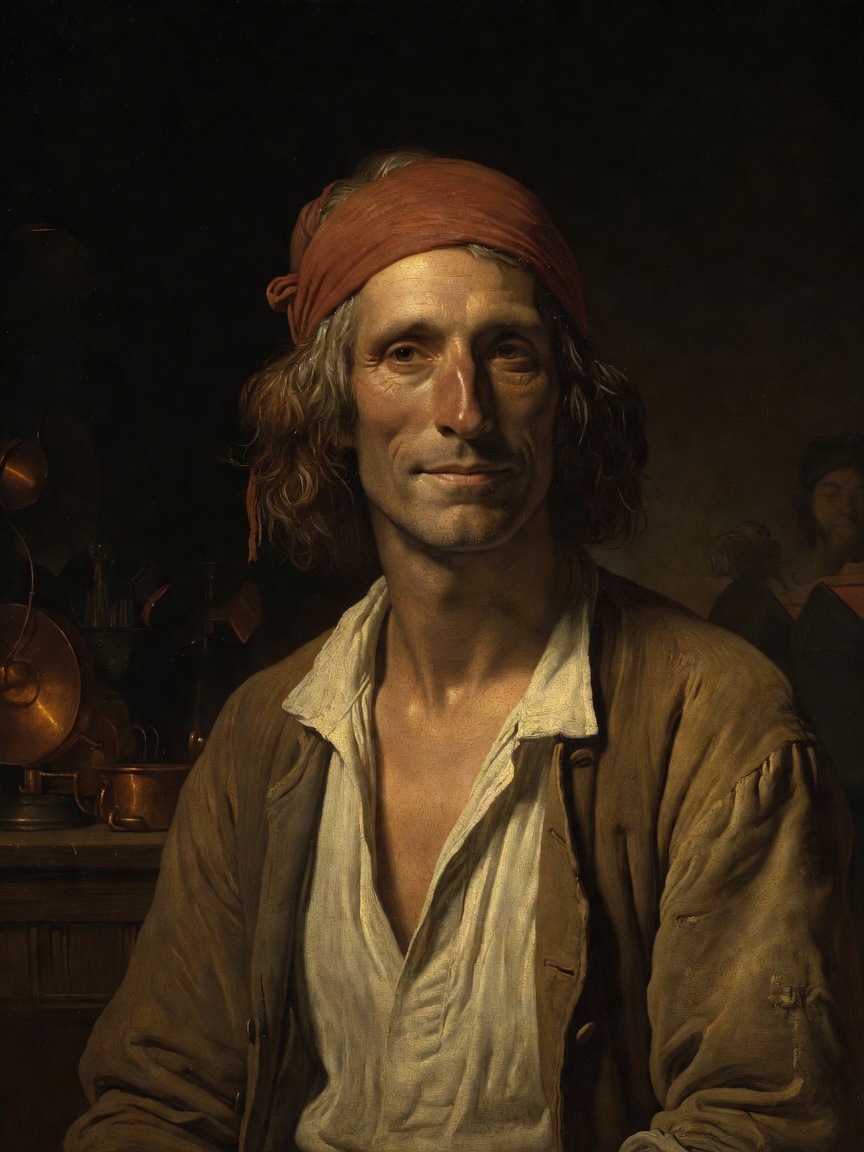
A lean, weathered man in his late forties to early fifties with a gaunt, angular face marked by deep lines and a contemplative expression.
He has shoulder-length, thinning auburn-brown hair pulled back with a fabric headwrap or headband, with receding hairline and sparse coverage at the crown. His eyebrows and eyelashes are present but sparse.
Olive-toned, weathered skin with a rough, textured complexion bearing the marks of hardship and exposure. His eyes are deep-set and penetrating, with a slightly hollow appearance.
He typically wears simple, worn clothing
He typically wears simple, worn clothing: loose linen or cotton shirts in cream or light brown, often unbuttoned at the collar, paired with coarse brown or tan jackets or waistcoats showing visible wear and stains.
The overall impression is of a humble, possibly working-class or impoverished figure from an earlier historical period, with an air of quiet dignity despite material hardship.
Identity
- Gender
- Male
- Nationality
- English
- Origin
- Norwich
- Ship · 1725
- Mast of Crows
- Ship · 2025
- —
- Berth
- Able Seaman
- Bounty
- 3643
Frestagon Profile
Compiled by Dr. Frestagon from observation rather than testimony. Scores out of ten; the commentary is his own.
- Education (8) — formidable; rarely caught improvising.
- Charm (7) — serviceable, and aware of its limits.
- Command (7) — serviceable, and aware of its limits.
- Cunning (5) — middling; compensated for elsewhere.
- Lore (4) — middling; compensated for elsewhere.
- Intuition (4) — middling; compensated for elsewhere.
- Strategy (3) — a documented weakness. Exploit with care.
- Navigation (3) — a documented weakness. Exploit with care.
- Empathy (1) — a documented weakness. Exploit with care.
Filed under seal. The subject has not seen this assessment.
Saltwell Profile
Leadership, as the Admiral's office measures it.
Blackwater Profile
Intelligence and tradecraft, by Blackwater reckoning.
Tidecrest Profile
A woman's appraisal — of a woman as she is, or of a man as he believes himself to be.