Rodrigo Costa
- Ship
- Sandhill Captain
- Position
- storm lord
- Faction
- The Cathedral
- Territory
- Brine Gate Harbor
Backstory
THE LEDGER AND THE STORM: A CHRONICLE OF RODRIGO COSTA
PART I: THE MERCHANT’S MATHEMATICS
A counting house above Cádiz’s wharves smelled of beeswax and the particular salt that soaks into wood after months near harbor — salt ground into ledger spines, into the merchant Vásquez’s fingertips, into the marrow of a boy who would come to be called Storm Fang.
The child arrived without ceremony, laid
The child arrived without ceremony, laid on straw in that room of columns and transaction, and was recorded in Vásquez’s hand as Arrival, uncertain origin, March 1688. Provisions estimated quarterly. No mother’s name. No father’s mark.
Only the austere grammar of commerce, which demands that every thing — even an infant — be recorded as cost.
By the time Rodrigo Costa could reach the high stools without climbing, he was sweeping the floor and learning letters from the margins of those ledgers.
The three pale clerks who worked
The three pale clerks who worked the desk taught him nothing directly; instead, he absorbed the ritual of it as a child absorbs a language by proximity. The cabinet unlocked. The spines emerged.
Debits left, credits right, and between them the truth of every transaction that had ever moved through that harbor.
By age ten he was copying figures, his small fingers learning the precise angle of a quill, his eyes sharp enough to catch what the older men — including the trembling clerk Ramón — routinely missed. A discrepancy of two reales in a manifest.
A ship’s arrival recorded but no
A ship’s arrival recorded but no cargo dispersed. The grammar of columns taught him that the world was legible only if you knew how to read it.
The crew called him the ledger rat because he seemed to nest in the margins, appearing and vanishing like something that belonged neither to the wharves nor to the respectable rooms above them. The name was not kind.
In 1700, when the boy was perhaps twelve, a Spanish revenue cutter arrived at the warehouse with the particular swagger of crown authority. Its captain, Córdoba by name, possessed the contempt that comes from wearing the law like a coat.
He demanded an extra cask of
He demanded an extra cask of powder — powder that did not appear on Vásquez’s manifest. The merchant refused. Córdoba smiled the way a man smiles when he has already decided the matter settled, and he returned that night with two men from his crew.
Rodrigo watched from the loft where he had been cataloging iron bars. The warehouse door opened without resistance — someone had taken payment to leave it unsealed.
The men moved through darkness with the confidence of thieves sanctioned by law, carrying the cask upward while Vásquez appeared on the stairs, unarmed, and told them to stop.
What happened after was brief and
What happened after was brief and did not end with the merchant’s skull crushed, though it approached that conclusion. The men left without their prize and took only wounded pride.
That night, the boy who still possessed no proper name slid down a rope into the warehouse floor and moved through darkness he had learned to navigate by memory and sound.
The cutter rested at her moorings unguarded — the captain had not anticipated retaliation from a merchant he had already dismissed. Rodrigo carried a marlinspike taken from the riggers’ workshop.
He knew the cutter’s hull well
He knew the cutter’s hull well enough; he had walked past her that morning, marking the waterline, noting the position of the sea cocks beneath her counter. The metal was cold and salt-rough under his fingers.
Three turns of the spike before the first cock opened. The second came easier. He heard the water rushing before he pulled himself back onto the dock.
By morning, the cutter rested on mud with her stern tilted at an angle that would require weeks and considerable expense to correct. Córdoba did not wait to see her salvaged.
He departed Cádiz that day, and
He departed Cádiz that day, and the incident was recorded nowhere — to record it would have been to admit that revenue cutters might be vulnerable to the very merchants they policed.
Vásquez asked no questions. He handed the boy a tarred canvas coat stinking of pitch and, the following dawn, placed him aboard the Santa María de Gracia, a packet bound for Veracruz1 with iron bars and Catalan wine.
He told the master, a man named Hernández whose face had been weathered the color of old mahogany, that the boy could read and write, and that he kept watch books.
“Then he will be useful,” Hernández
“Then he will be useful,” Hernández said. “If he is not, I will make him so.”
PART II: THE LIGHTNING AND THE SCAR
The passage to Veracruz was instruction written in rope and salt water. Hernández beat the names of every sail into the boy’s body — mainmast, foremast, mizzenmast, topsail, topgallant, royal — using the knotted end of a line as his teaching instrument.
Rodrigo learned them not because the
Rodrigo learned them not because the pain was instructive but because precision was safer than ignorance. Muscle and bone absorbed the language before his mind could properly form the words.
By the time the Santa María reached the Caribbean and discharged her cargo, he understood the grammar of rigging in his shoulders and wrists.
The return voyage, three weeks out and north of the Azores, brought the barometer falling three-tenths within an hour. Hernández’s weathered face changed color — from mahogany to ash — and he ordered the topgallants struck immediately.
The sky darkened from iron-grey to
The sky darkened from iron-grey to the color of a bruise. The wind came in gusts that seemed to test the masts themselves. When the storm arrived, it came like a wall of slate.
The boy — still fourteen, still learning what it meant to belong to a vessel — was sent aloft to cut the burning halyards when lightning struck the foretop.
He felt it before he understood it: a white flash that seemed to originate inside his own skull, a sound like copper bells struck underwater, and then burning along his left cheek as the bolt traveled down the mast and out through his flesh.
The smell of his own burnt
The smell of his own burnt hair reached him a moment later. He clung to the yard with both hands and both feet, and the crew below swore they saw him baring his teeth at the sky — defiant or mad or both.
When the Santa María limped into Funchal three days later, Hernández pulled him from the rigging and examined the scar by daylight.
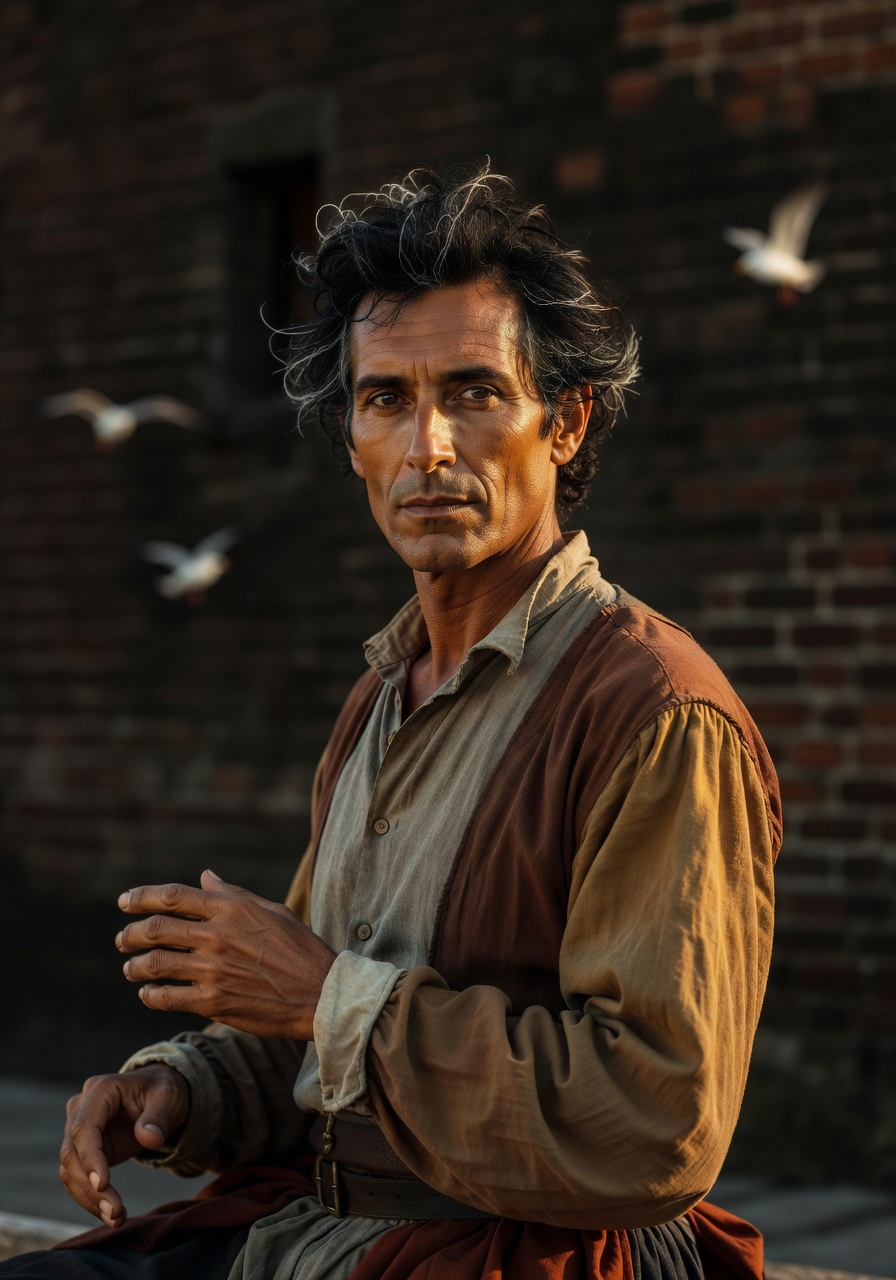
It ran from the corner of his mouth to his temple, thin and white, pulling the lid of his left eye slightly higher than the right. The eye beneath it had changed color — darker now, the color of water when a storm approaches. The eye of someone struck by heaven and conscious enough to resent it.
“Storm Fang,” Hernández said, running a
“Storm Fang,” Hernández said, running a calloused thumb along the wound. It was not a question.
The master paid him half wages and pointed him toward the docks. The boy, now bearing his new name like a brand, understood without being told that his apprenticeship was finished. He never returned to Cádiz.
The counting house would go on recording transactions without him, debits and credits balancing in the dark, the grammar of commerce continuing its indifferent work.
But Rodrigo Costa — scarred, darker-eyed
But Rodrigo Costa — scarred, darker-eyed, marked by lightning — had learned all the arithmetic he required from ledger columns. The sea would teach him the mathematics of power.
At sixteen he took passage on a Havana2 trader running untaxed sugar between Cuba3 and the Leewards. In the first port the master shorted the crew their advance.
Rodrigo waited until the man was drunk, then lifted the strongbox from beneath the cabin sole with a bent sail needle and greased cord. He left the master asleep and the box empty on the tavern table, taking only what the crew was owed plus one extra doubloon for the scar.
The master woke to an empty
The master woke to an empty berth and a port that offered no extradition for such minor thefts.
Rodrigo walked the waterfront until he found a vessel whose master needed a man who could read a chart and keep his mouth shut. The decks smelled of cedar and old blood. He stepped aboard without looking back at the packet, the counting house, or the city whose ledgers had once been the only world he knew.
The scar and the darker eye became the marks men remembered.
In later years, when he stood
In later years, when he stood on a deck with the wind cutting across the scar tissue along his jaw, the crew watched the left side of his face and spoke his name with a mixture of deference and unease — the way men speak of things that have been touched by forces beyond law or mercy.
He would come to captain the Sandhill5, and in the Golden Age of the Brethren, Storm Fang would become a name whispered in harbors from Port Royal4 to Saint-Domingue.
But it all began in a counting house, with a boy learning to read the world as transaction, as balance, as the space between what is owed and what is taken.
Appearance
"Storm Fang" | Captain, Sandhill | The Cathedral6
[rest of physical description text remains unchanged]
Career
RODRIGO COSTA, CALLED STORM FANG
A RECORD OF SERVICE, COMPETENCE, AND ACTION AT SEA
================================================================================
ESTATE & ORIGIN
ESTATE & ORIGIN
Rodrigo Costa entered the world without pedigree or patronage, recorded as Arrival in the counting house of the merchant Vásquez above Cádiz’s wharves in the spring of 1688.
He was raised among ledgers and harbor commerce, learning the grammar of transactions before he learned the names of sails — a boy of no declared origin who came to read the sea as he had read the columns of debits and credits.
In 1700, when certain men who
In 1700, when certain men who wore law as though it were a privilege came to take what was not theirs, he learned that the world answered only to those who chose to answer back, and in that year Vásquez placed him aboard the merchant packet Santa María de Gracia, bound for Veracruz under the command of Master Hernández, a man whose methods were precise and whose mercy was measured in fathoms.
================================================================================
COMMISSIONS
Santa María de Gracia, Packet Merchant
Santa María de Gracia, Packet Merchant. Apprentice Rigger and Watch-Keeper, 1700–1702. Master Hernández instructed the boy in the full complement of rigging through method, repetition, and considerable pain applied with a knotted line.
By the end of his tenure, young Costa could read weather in the set of canvas and knew the language of the yards as intimately as speech. Consequence: the master noted in his log that the apprentice possessed the eye of a man three times his age, and recommended him onward to deeper waters.
Nuestra Señora del Carmen, Merchant-Escort. Bosun’s Mate and Sailing-Master’s Assistant, 1702–1706. Costa joined a larger vessel tasked with carrying payroll and letters of credit between Spanish colonial ports.
He rose rapidly, his grasp of
He rose rapidly, his grasp of navigation and his ability to anticipate disorder before it took hold marking him as a man of unusual resource.
The crew came to call him Storm Fang for the quickness with which he moved through a confused watch and the precision with which he ordered chaos.
Consequence: during a engagement with three Barbary corsairs off the Balearics, he led the defense of the mainmast when the sailing-master fell wounded, and held position until the escort vessels closed.
La Providencia, Privateer (Licensed). Sail
La Providencia, Privateer (Licensed). Sailing-Master and Second Officer, 1706–1709. With the opening of privateering commissions during the War of Succession, Costa shipped aboard a vessel sanctioned by the Crown to take enemy merchant traffic.
He proved a navigator of exceptional acuity and a tactician who understood that a ship was won or lost in its preparation, not in the moment of contact.
Consequence: La Providencia took seventeen prizes under his direction of the deck, and Costa himself boarded five, collecting a scar across his left ribs and a reputation among the Brethren that extended from Havana to Port Royal.
The Sandhill, Pirate Merchant and Raider
The Sandhill, Pirate Merchant and Raider. Captain and Master, 1709–1725. Costa accepted command of the Sandhill in the year 1709, a ship that had begun her life as a Spanish merchant brigantine and had been taken by force and re-rigged for the free trade.
Under his hand, the Sandhill became a vessel of precision — every line known, every man accountable, every action ordered toward the accumulation of plunder and the preservation of crew.
He flew no colors but his own and answered to no authority save the code of the Brethren and the mathematics of survival. In sixteen years, the Sandhill took forty-three prizes of consequence, and only one vessel ever escaped by superior sail.
Costa maintained a ship’s log that
Costa maintained a ship’s log that rivaled a Crown navigator’s in its detail, recording position, cargo manifested, crew shares distributed, and the names of the dead. Consequence: the Cathedral claimed him as one of its own, and the name Storm Fang became a warning from Kingston7 to Cartagena.
================================================================================
COMPETENCIES
Navigation and Celestial Reckoning. Costa
Navigation and Celestial Reckoning. Costa reads the stars and the sun with the precision of a man for whom calculation is as natural as breathing. He maintains accurate reckonings even in foul weather, having learned the mathematics of position before ever he touched a quadrant.
Harbor Intelligence and Chart Reading. Bred in a counting house that recorded every movement of merchant traffic, he reads a harbor the way others read faces — the positions of vessels, the guard rotations, the pattern of provisioning.
He knows the depths and the shoals of a dozen major ports, and has added several of his own devising.
Crew Command and Discipline. He understand
Crew Command and Discipline. He understands that a pirate crew is governed not by fear alone but by the promise of share and the certainty that its captain will not ask what it will not give. Men follow him because they have seen him stand the watch in storm and because his share of plunder is drawn like any other’s.
Rigging and Sail-Craft. Few men alive know the full vocabulary of a ship’s canvas and rigging as thoroughly as Costa does. He can read damage at a distance and diagnose a vessel’s speed from the set of her sails alone. He has redesigned the running rigging on the Sandhill twice to gain advantage in pursuit.
Accounting and Prize Distribution. The counting-house boy never left him entirely. Costa keeps a ledger that would satisfy the Crown’s own customs men, recording every prize, every share, every obligation. This precision has prevented mutiny and maintained the loyalty of a crew for sixteen years.
Tactical Engagement and Boarding. He has
Tactical Engagement and Boarding. He has boarded five-and-twenty vessels under arms and taken only three casualties among his boarding parties. He understands that a prize is more valuable captured than burned, and that efficiency in violence is preferable to spectacle.
Reconnaissance and Agent Networks. Through years of privateering and independent trading, Costa has cultivated sources among harbor masters, merchants, and Crown officials who prefer to speak with those who might reward them. He often knows where a vessel will be before the vessel’s own master does.
Coastal Navigation and Refuge. He has mapped the hidden waters of the Caribbean coast — the inlets, the reef channels, the small harbors where a pursued ship might anchor beyond the reach of navy guns. The Brine Gate harbor itself came to light through his discovery and his direction.
==========================================
================================================================================
NOTABLE ACTIONS
In 1704, commanding the deck of La Providencia, Costa captured the Spanish merchant-brigantine Santa Rosalía carrying Peruvian silver and indigo, taking the vessel intact and executing her captain only when the man refused to lower colors — a decision that cost one of Costa’s own men and gained the Brethren nearly thirty thousand pieces of eight.
In 1711, the Sandhill was cornered
In 1711, the Sandhill was cornered in Cartagena harbor by three Spanish patrol vessels.
Costa ordered his men to veer into the shallows where the deeper-drafted warships could not follow, navigated by memory through a channel he had walked on foot five years prior, and escaped into open water while the patrol ships ran aground in succession.
In 1718, he intercepted and took the merchant vessel María Concepción8 carrying a shipment of sealed correspondence bound for the Spanish Crown — letters that detailed the movements of three major naval squadrons. These were distributed among the Brethren for considerable profit and strategic advantage.
The Sandhill and her sister vessels
The Sandhill and her sister vessels, operating under the implicit authority of the Cathedral, have taken or sunk more than seventy vessels of Spanish, Portuguese, and French registry, disrupting trade routes across the Caribbean and the Atlantic approach for nearly two decades.
================================================================================
REFERENCES & REPUTATION
Costa stands among the highest-ranked comm
Costa stands among the highest-ranked commanders of the Cathedral, regarded with respect bordering on deference by the common captains of the Brethren and viewed by Crown authorities across the Spanish Main as a threat of the first magnitude.
Those who have served under him speak of a man who keeps his word with precision, shares plunder fairly, and does not demand what he will not give.
His enemies number in the hundreds and are scattered across the Caribbean, the Spanish ports, and the corridors of royal authority — men who have lost ships, cargoes, reputation, and blood to the Sandhill and her captain’s calculation.
The merchant houses of Cádiz, Seville
The merchant houses of Cádiz, Seville, and Veracruz have placed a considerable bounty upon his name, though none who have collected information on the Sandhill’s whereabouts have lived to claim it.
Identity
- Gender
- Male
- Nationality
- Spanish
- Origin
- —
- Ship · 1725
- Sandhill
- Ship · 2025
- North Miami
- Berth
- Captain
- Bounty
- 98000
Family
Parentage reset. Mother: unknown. Father: unknown.
Frestagon Profile
Compiled by Dr. Frestagon from observation rather than testimony. Scores out of ten; the commentary is his own.
- Cunning (10) — at the ceiling. Assume premeditation.
- Strategy (10) — at the ceiling. Assume premeditation.
- Command (9) — at the ceiling. Assume premeditation.
- Charm (8) — formidable; rarely caught improvising.
- Empathy (7) — serviceable, and aware of its limits.
- Navigation (6) — serviceable, and aware of its limits.
- Education (5) — middling; compensated for elsewhere.
- Intuition (4) — middling; compensated for elsewhere.
- Lore (3) — a documented weakness. Exploit with care.
Filed under seal. The subject has not seen this assessment, which is for the best.
Saltwell Profile
Leadership, as the Admiral's office measures it.
Blackwater Profile
Intelligence and tradecraft, by Blackwater reckoning.
Tidecrest Profile
A woman's appraisal — of a woman as she is, or of a man as he believes himself to be.